Sunday, July 6, 2014

O2 sensor ground, is it rusty? Make it easier to remove for the next guy....that might just be you.

**Sept 22 update:
Original article:

O2 sensors being grounded by the exhaust, is a concept for 1 wire O2 sensors. 4 wire O2 sensors are wired with their own ground and are not grounded by the exhaust.**


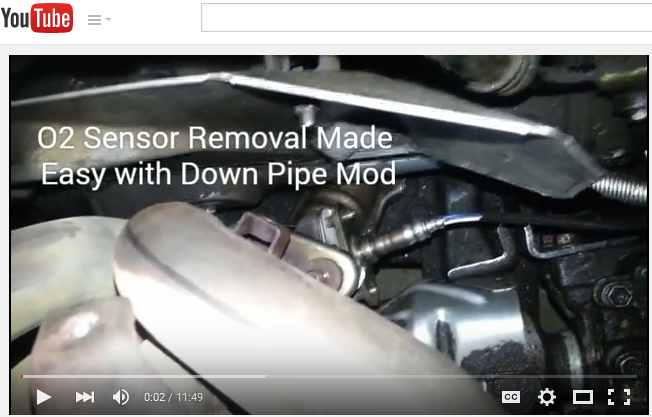
I hadn't thought about checking if the O2 sensor was cleanly grounded. Cleaning up rust always helps O2 Sensor Mod and Diagnosis)with a good connection. Yes, anti-seize. When I was early DIY rather than nearly a technician I installed a new O2 sensor, up river, and got my 1999 Chevrolet Prizm running nicely again (same as 1998-02 Toyota Corolla). The Chevy wasn't that rusty then. Now....until I own an acetylene torch or replace that manifold that O2 sensor better not fail. So rusted in (I can't take the down pipe off my manifold until the oxygen sensor is out of the way. Thankfully just replacing one of the springs cleared the exhaust leak ...still wanting a new doughnut gasket in there, but don't fix what isn't broken, it runs soooo much better). . . So yes, use anti-seize but don't get any on the sensor! (8/23/15 update: The aftermarket Bosch oxygen sensor appeared to have a normal oxygen sensor socket install, but it actually includes a flange with 2 bolts. It's an interference fit with the down pipes. I've made a video with the solutions! I got back to a OEM Denso which you can see doesn't have a nut next to the flange, which confused me into believing it wasn't removeable.)


Anyway, I just meant to say that only 8 years ago I installed the Bosch oxygen sensor and I wish I knew to put in anti-seize. The rust really isn't that bad but it's enough. I destroyed my harbor freight oxygen sensor socket...may have already done that a few job's ago that I worked around not removing the oxygen sensor. I now have a much more expensive Powerbuilt socket (never in water, quickly rusted. :p - got it super cheap on Amazon, maybe it was a Powerbuilt knock off). I haven't bought a lot from them, but whenever I break an inexpensive tool, I replace it with this brand and I never have a problem again. My new Powerbuilt O2 sensor remover worked brilliantly. It's removing all the oxygen sensors that I thought were rusted in badly, almost easily.


The last Bosch oxygen sensors I installed on my mom's 1999 Mercury Sable ran okay...but with them all new it ran sooooo much better (Same as 1999 Ford Taurus). I was surprised that the down river O2 sensors helped it run better....I guess the car's willing to run a little richer for some punch when it's not dirtying the environment? I might have imagined that part of the improvement. Bosch includes the perfect amount of anti-seize on the O2 sensor threads now. I had to love them for that little touch.

And remember, don't blame an oxygen sensor or a catalytic converter for an exhaust leak. I have a live scanner now and my new cat gave me 50% more horse power (possible to find out using a torque app and some open freeway, gps confirmed *HP as long as you report the weight of your vehicle accurately) and almost removed the condition of the rear oxygen sensor voltage switching up and down too quickly. That shows on my live scanner ...sign of a bad cat? Sure. The catalytic converter does a lot better, but you can't have an exhaust leak before the cat and know for sure if that cat is really bad without checking upstream before you finish your diagnosis.

The old catalytic converter nearly showed the same reading before and after the catalytic converter indicating that it was almost doing nothing for the car. Need more analysis for how O2 sensors should be running? Check out my article and video on the subject. Here's a link to O2 Senors, The 4 Stages of Death.

by AutoBravado

Saturday, April 12, 2014

Weapon R Dragon Intake Review

I recently purchased a Weapon R Dragon Intake for my 1999 Chevrolet Prizm. To give you some history, my choice for this upgrade was different than you might think. I didn't just go in to get a short ram intake because I wanted an upgrade. About 3 years ago my car got smashed and and I had to replace 1/2 of my headlights and signal lights...not to mention my bumper. ;) A had a large canister inside the bumper that was supposed to help get some cold air into the car that broke and could not be put back in. Seeing as how the whole system still looked sealed from the weather, I counted my lucky stars and left a gaping hole that could gulp cold air into my car rather than sip through 5 tiny holes that the canister breathed through.

A couple months ago, I noticed that my wheel well was getting less sealed to the bumper and I was risking Hydro-lock. Hydro-lock is where water goes into your air intake system, combines with the fuel/air mixture and doesn't compress - water doesn't compress - and "BAM!" Your engine is broken and will often need replacement. So, terrified, knowing I was coming up on a typically rainy drive soon I needed to fix this situation fast.

I didn't even want to figure out how to replace the air canister. I didn't really know what it was called and suspected a very high price at the dealer or no availability for a part since the dealers don't sell much past 10 years. So....I went for the fix and upgrade replacement Weapon R Dragon Intake.

The Weapon R Dragon Intake came in a record fast time, a day before my road trip so I didn't have to spend valuable driving time on installation. Quite excited, I was in my car clothes within minutes and I was installing it.

I immediately noticed the extra loud noise that was new to my car. Everyone said online that the Weapon R Dragon Intake was the loudest intake on the market. (Most seem excited about that.) This worried me because I love performance but I don't like things being too loud. Turns out, once it warms up, it's pretty quiet. Plus, I really only notice the sound of the Weapon R at low speeds.

I immediately noticed that my 2.5 inch opened exhaust was louder, and that was driving gentle, since I'm all about getting the best car mpg possible, I was excited that this was a sign that my car was getting more air moved through it, dragon style :). On my trip, I had to go over mountains and I quickly noticed that when I came out of overdrive for these mountains that instead of my car sounding like it was working hard, the hills sounded natural.

Two days before my trip, I lost valuable preparation for my traveling installing the Weapon R Dragon Intake, I made up for lost time and drove faster. I usually notice a drop in car mpg when I do this, but my car mpg stayed the same even though I was driving faster. I'm not much of a speeder, I just more frequently did 80 in the posted 80 mph zones when I more often go about 75 because I get better mpg that way.

The short of it? I notice some areas where I believe I have more acceleration. It's hard to tell when I just replaced the valve that makes my 1999 Chevrolet Prizm have it's year 2000 motor with VVT-i fully functional. This valve syncs up the oil flow in the valves based on the RPM of the engine based on what the Cam Shaft Position Sensor is telling the engine what to do. This already opened up a lot more power 2 weeks ago, so not being used to that I can't really tell you. I haven't seen enough car mpg numbers to report yet, but when I do, I'll do less of a story and more of an article on my main autobravado website.

Car mpg numbers included now! Weapon R Dragon Intake Review - final review?

*Note: 1999 Chevrolet Prizm is the same as a 2000 or 2001-02, except that my 1999 Chevrolet Prizm has a 2000 LSI engine with improvements not available in 1999. Except the one improvement of a variable valve timing (VVTi), it's the same engine and parts for anything you'd replace except in association with those valves. This was during a time that Chevrolet and Toyota were in a joint partnership and made the car together, so it really is a Chevy and a Toyota, a 1998, 1999, 2000. 2001, or 2002 Toyota Corolla are the same as well.

Add snow to the AutoBravado car for extra beauty. :)
Written and produced by AutoBravado.

Monday, June 21, 2010

A Car's MPG and Iridium Spark Plugs

If you want it simple to start, I don't think iridium spark plugs effect the car's mpg entirely. My first experience with the iridium spark plug in my car was that it moved a lot faster, that the engine stayed tuned more easily, and the easier it is to have an engine running smooth and easy, the more efficient it is, but technically I can have that result with platinum spark plugs, as far as the tuning goes, but it's much more effort requires re-gapping the spark plugs frequently. So, as a whole, the iridium spark plug will get you better mpg for your car, but not necessarily on the short run. The iridium tip is much smaller than the standard spark plug for the 1990's, which it allows it to get to the self-cleaning temperature faster, prevents spark plug fowling, and allows for the lightning that a spark plug makes to be at the appropriate spark plug gap better than if it was wider. You see, as the materials in a spark plug corrode or erode over time it'll make the lightning go to the side of a plug, rather than the center, and this can throw off the actual distance the spark is going versus what your spark plug gapping tool can measure. This is one of the reasons replacing plugs that work good will save you money, and this is another reason the iridium spark plug will last longer. To learn more about iridium spark plugs, go to my NGK Spark Plug Advantage page.

Update 9 months later: I would have had to replace these iridium spark plugs if they had the longevity of platinum's by now. Not that the platinum spark plugs wouldn't have kept working, but they'd be effecting my car's mpg negatively.

Note: I had the iridium spark plugs in my car since the summer of 2009. It's just now time to check their gap, let alone the fact that I'd usually would have had to replace them by now. Be careful when adjusting and checking gaps on iridium's! The iridium tip for the electrode breaks off easily! When adjusting the prong above them, don't pry against the electrode. Use pliers and just touch the prong that reaches up and over from it's sides. See my 3 spark plug gap articles via this word link spark plug gap.

How about some legitimate hands on for spark plug and wire balancing technique!
by AutoBravado

Monday, March 1, 2010

Car MPG

In honor of this new website - one of many by me if you'd like to explore my profile, you'd only find about a 1/4 of what I've made and taken the time to market, for traffic, not necessarily money - anyway ... in honor of this new blog, where I've promised myself more creativity and less strict creation that matches the concepts that lets you get found on Google - I'm freelancing these skills, feel free to email me if you'd like to pay for plenty of Search Engine Marketing (SEO) tricks, and I've mentored enough students to know that I can teach the skills, but I digress! (I love to digress, thus the more relaxed blog!) The main point: CAR MPG.

What have I learned about the car's mpg (miles per gallon) lately? You can't believe Mythbusters with everything they say. I have data that proves otherwise, and I read a great article online that matches my results exactly, though he has 50 years of experiments proving it, while I just have an about 800 mile trip where it worked great in a Toyota Sienna. The article in question? Acetone in gasoline! On a few occasions, but all the car mpg advice I've EVER given has a tendency to need the old phrase, "Individual results may vary." Because, I admit in the article where I've seen and appropriate amount of acetone in gasoline: 1 to 4 ounces per ten gallons, depending on the vehicle and how you drive depends on how much you put in, and it doesn't work at all in some cars. I give Mythbusters, unlike my colleague's website, (colleague in the sense that he studies the same thing as me, not that we know each other nor do I remember how to get to his website! If I find it I'll share - he has great data!) I give Mythbusters the fair chance that acetone in the gasoline decreased that car's mpg. My colleague suggests that imperfectly timed engines will make acetone do worse, but in my car, I'm sure that it was because the fuel injectors did all too well, making my beloved mpg dive out the back of the exhaust at 4 times the rate it should - ten, not 40 or 50 mpg on that trip! Argh!

3/25/2010
Haven't had enough? I wrote my first internet article once to try to encompass as much as possible the most basic things I knew to better the good 'ol mpg. See: Car or Truck Miles Per Gallon. Note: It's changed gently over the years to be up to date, be smoother, and link to a few more articles.
Two days ago I wrote a new blog. The Truck Miles Per Gallon. The perfect companion to this website: The Car MPG. That new website picked up a lot of traffic early and fast!

4/06/2010
Correction: noticed I'd said the 800 miles was in a Toyota Avalon, but it was a Toyota Sienna, a van. I knew that! :)

by AutoBravado